The rewards of sustainable practices
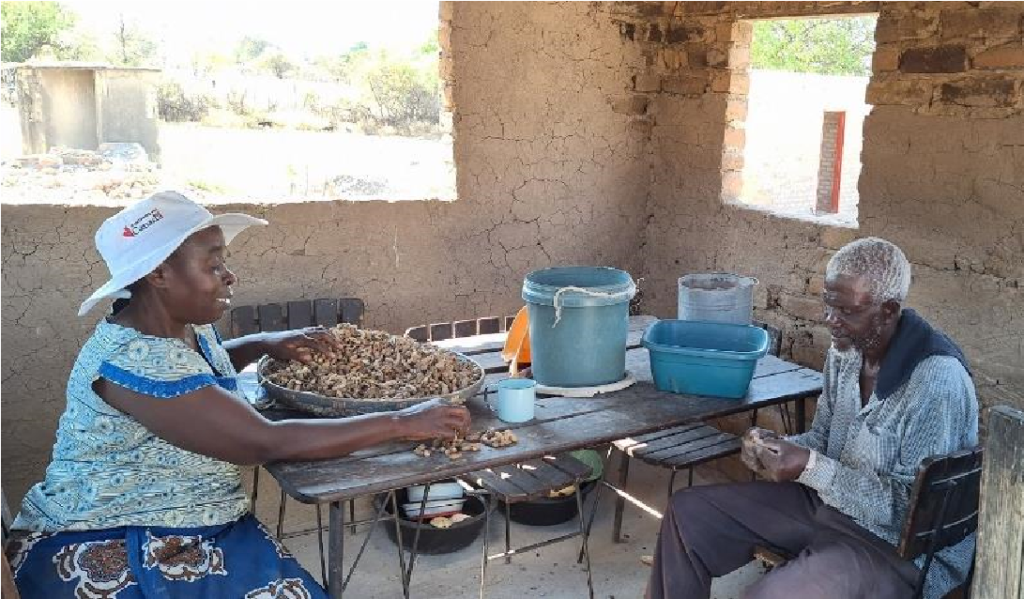
In Mahlokohloko, Ward 4, Gwanda North, 59-year-old Maidei Ndlovu and her husband, 63-year-old Bisei Sibanda, have become symbols of agricultural transformation through conservation agriculture (CA). Living with their two sons, the family have cultivated not only crops but a model of resilience, sustainability, and partnership that inspires their entire community.
As a dedicated lead farmer under the LINCZ Program, implemented by BIC-CDS, Maidei guides other farmers in adopting sustainable farming methods. Recognized by her community for her leadership and practical expertise, she serves as a trusted resource for knowledge sharing and innovation in sustainable agriculture. During the 2024/2025 farming season, the family received seed support and harvested six bags of unshelled groundnuts, 20kgs of cowpeas, and 100kgs of sorghum despite heavy rains that affected the crops. Demonstrating sound seed management, they selected sorghum grains to establish a household seed bank. These seeds were carefully stored in airtight containers layered with river sand to preserve their viability, ensuring future planting and enhancing household seed sovereignty. They harvested velvet beans and lablab, producing 17 haybales used to feed their livestock. They also gathered pods from indigenous trees commonly known as Monkey bread, Ihabahaba (isiNdebele) or Mutukutu (Shona).
In preparation for the 2025/2026 farming season, the family began land preparation in June, immediately after harvesting. They cultivated 0.12 hectares with 0.05 hectares under sorghum surrounded by 607 basins planted with millet. The millet serves as a natural trap crop, attracting birds away from sorghum fields during the early maturity stages, thereby reducing pest damage without relying on chemicals. To maintain soil fertility, they enriched the land with organic manure from cattle, goats, and home-made
compost. They have also maintained continuous ground cover by excluding livestock from crop fields, reducing erosion, preserving soil moisture, and promoting biodiversity. Two weeks after crop emergence, legumes will be intercropped to enhance nitrogen fixation, naturally improving soil fertility and crop yields. Through these practices, the family has reduced labor demands, improved soil health, and increased productivity. Their environmental commitment extends to agroforestry. The family has planted trees provided through environmental conservation initiatives, further contributing to climate adaptation and ecosystem restoration. Beyond the fields, the family household embraces shared responsibility and gender equality. Both husband and wife participate in gender awareness dialogues encouraged under the LINCZ program. As a result, Bisei actively supports Maidei with household and fieldwork duties, easing her workload and strengthening their partnership. Together, they make joint decisions and collaborate on farm activities to monitor progress and inform best practices.
Maidei Ndlovu took her leadership role a step further by hosting an inter-ward learning visit at her homestead. The exchange brought together 17 farmers from Ward 11 of Gwanda south, who came to learn first-hand about conservation agriculture (CA), water harvesting, integration of indigenous knowledge system and other agronomic practises.
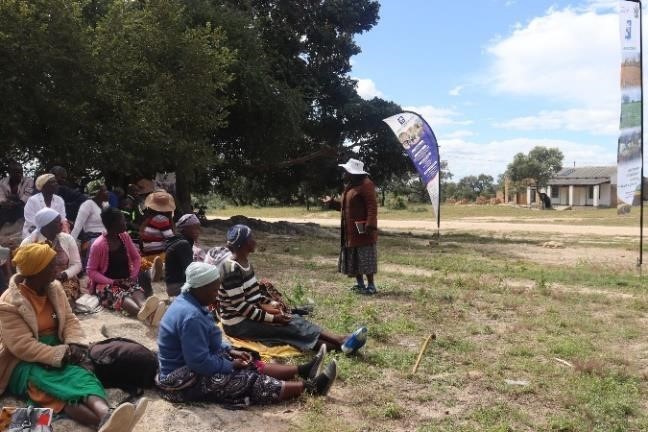
Together with her husband, they shared their journey towards adopting sustainable farming techniques and how these practices have transformed both their livelihoods and their approach to collaborative household management. The couple spoke about the importance of joint decision-making, equitable workload sharing, and mutual support values that have strengthened their partnership and enhanced productivity on their farm. During the visit, participants toured the Sibanda family’s CA plots, where they observed key elements of successful implementation, including permanent mulching, permanent basin, and soil fertility management using manure and compost. The family also demonstrated effective water harvesting measures such as the construction of dead level contours for runoff control and the digging of shallow wells within fields to improve water availability for crops throughout the growing season. These practical demonstrations allowed visiting farmers to see how integrated soil and water conservation strategies can be implemented using locally available resources. Many expressed appreciations for the innovation, noting how such techniques could improve resilience to erratic rainfall and conserve soil moisture in their own households.
The positive impact of their efforts has been far-reaching. Income from their improved harvests from the previous years of practicing CA supports their daughter’s nursing education in Zambia, lifting the family toward greater economic security. Environmentally, their integration of indigenous knowledge and modern CA techniques has enhanced soil health, biodiversity, and resilience to climatic stress. The family’s journey shows how conservation agriculture combined with knowledge sharing, gender equality, and local leadership can transform rural livelihoods. Their example stands as a living testament to the power of ecological farming, community collaboration, and shared vision for a sustainable future.